Articles & Inspiration.
The Home Sanctuary: A Sacred Space for Daily Practice and Soul-Aligned Love
by Erin Reynolds
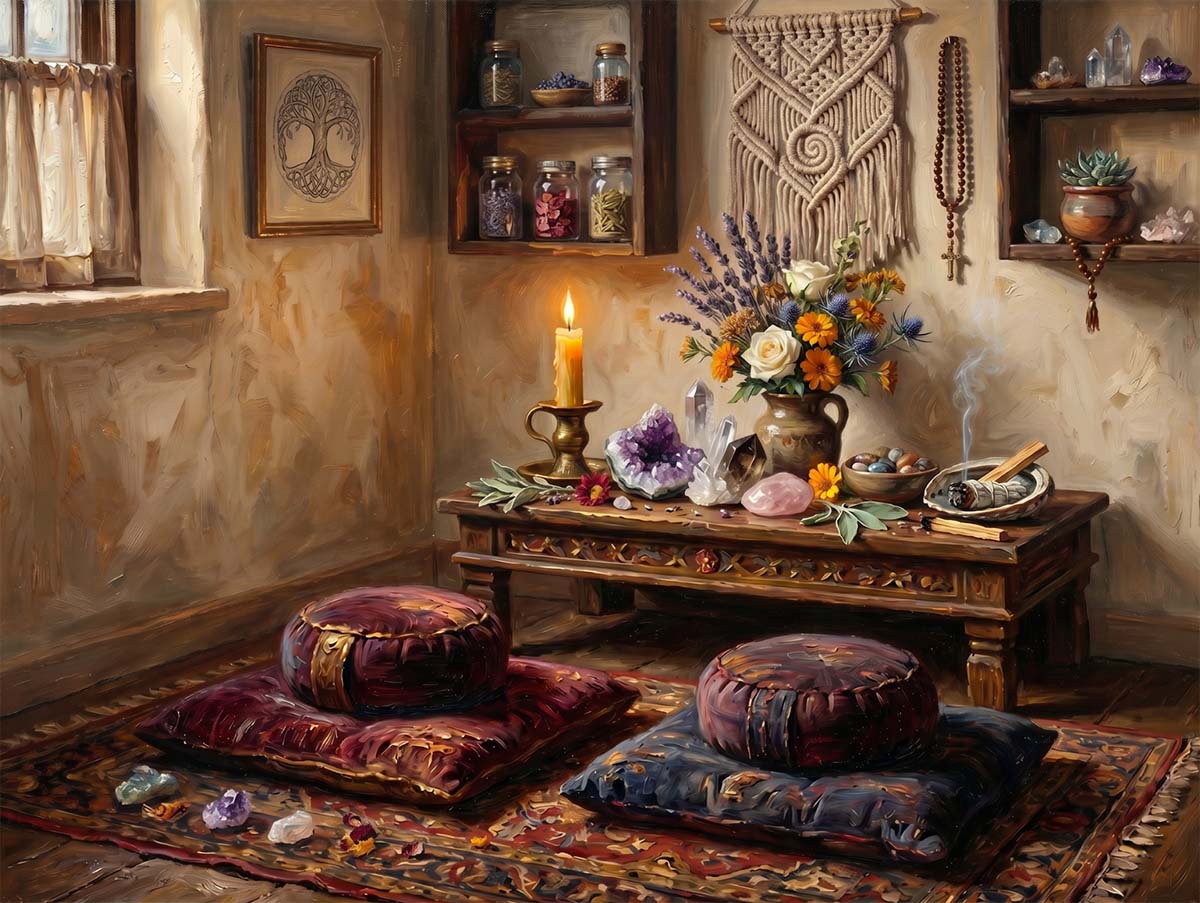
A sacred space at home is a deliberately chosen area you return to for spiritual practice, from meditation and prayer to journaling, breathwork, or quiet listening. It isn’t about being “perfect” or expensive. It’s about making it easy to come home to yourself every day, so your inner life isn’t always competing with clutter, noise, and momentum. Over time, that consistency becomes a subtle kind of preparation: you learn what steadies you, what opens you, and what patterns you’re ready to release—especially in love.
Here’s the gist
A sacred space works when it’s stable, simple, and used often. Choose a spot you can keep semi-set-up, give it a few meaningful anchors (not a hundred objects), and let sensory cues—light, scent, sound, natural texture—train your body to settle quickly. Then practice there regularly, not dramatically. Inner alignment grows from repetition.
Pick the right area (the space chooses you back)
Start with what your home can honestly support. Look for:
- Low foot traffic (so you’re not interrupted)
- A place you naturally pause (near your morning tea, beside the bed, by a reading chair)
- A surface you can keep clear (a small table, shelf, windowsill, or tray)
If privacy is limited, make it portable: a basket or tray that lives in a closet and comes out daily still counts. The real “sacredness” comes from consistent return, not square footage.
The energetic ingredients
Think of these as the invisible architecture of the space.
- Color: One dominant color is enough. Soft neutrals can feel calm and spacious. Deep blues can feel devotional and inward. Greens can feel renewed. Pick what reliably makes you exhale.
- Light: Soft, warm light helps your nervous system feel safe. Candlelight can be a powerful daily cue: I’m here now.
- Scent: A single, gentle scent used only in this space becomes a ritual “switch.” (Ventilation matters; subtle is better.)
- Sound: Silence works. So do a bell, chime, or a short playlist that signals “practice time.”
- Natural materials: Wood, stone, cotton, clay, and living plants tend to feel grounding and honest—less “decor,” more earth.
What each element supports
| Element | What it supports in practice | Simple examples |
|---|---|---|
| Color | Mood + meaning | Cloth, cushion, one accent object |
| Light | Focus + safety | Candle, salt lamp, shaded bulb |
| Scent | State shift | Essential oil, incense, fresh herbs |
| Sound | Rhythm + regulation | Bell, soft music, nature audio |
| Natural texture | Grounding | Wood tray, stone, plant, cotton |
The power of personal imagery (and how to make it truly yours)
Artwork in a sacred space can carry more weight than generic décor because it acts like an emotional and symbolic “tuning fork.” A mandala that mirrors your inner journey, a figure or guide you genuinely resonate with, or a landscape that holds the feeling of your highest self can become a steady anchor when you meditate or set intentions.
If you’ve ever searched for the “right” piece and come up empty, AI art generator tools have made it surprisingly accessible to create deeply personal spiritual artwork from a simple description of the symbolism, colors, and feeling you want to capture. The benefit isn’t novelty—it’s specificity: you can bring a one-of-a-kind image into your space that reflects your inner world instead of settling for mass-produced imagery that doesn’t quite fit.
Essential altar or meditation-corner pieces (keep it real)
You don’t need a crowded altar. You need a few anchors that make practice easier.
- A base: a cloth or tray to “contain” the space
- A focal point: candle, plant, meaningful stone, small statue, or simple symbol
- A practice tool: journal, devotional text, beads, timer
- A clearing cue: bowl of water, breath, a moment of silence, or a tiny dish for symbolic “offerings” (like a written intention)
If you add things, add them because you use them—not because you feel you “should.”
Recognizing the mindset as the container
Even the most thoughtfully designed corner only holds the energy you bring to it. That’s why cultivating an open-hearted mindset matters as much as candles or crystals. For spiritually conscious singles preparing for soul-aligned partnership, the daily practice is often where the shift happens: releasing limiting beliefs about love, replacing self-criticism with self-compassion, and choosing thoughts that match the relationship you want to live inside. When your inner world becomes kinder and clearer, your choices change—what you tolerate, what you reach for, what you recognize as aligned.
A resource to deepen your daily practice
If you want reliable guidance (especially on days when you feel scattered), UCLA Mindful offers a library of free guided meditations you can use in your sacred space. It’s practical, approachable, and easy to fit into a real schedule—five minutes is enough to keep the space “alive” through repetition. Many people find that a consistent, trustworthy voice helps them stay with the practice long enough for it to become a stable habit.
FAQ
Do I need spiritual tools (crystals, incense, etc.) for this to work?
No. Tools can help focus attention, but your attention is what makes the space meaningful.
What if I live with other people and can’t keep it set up?
Use a tray or basket you pull out daily. The ritual of setup + return can be part of the practice.
How does this connect to calling in an aligned relationship?
A consistent sanctuary strengthens self-trust, emotional clarity, and openness—qualities that make aligned partnership easier to recognize and sustain.
Conclusion
A sacred space is a daily agreement with your own inner life. Choose a spot that’s stable, keep the setup simple, and let sensory cues help your body settle quickly. Then return—briefly, consistently, sincerely. Over time, that steady inner refuge becomes the kind of growth-container that naturally draws aligned love closer.